
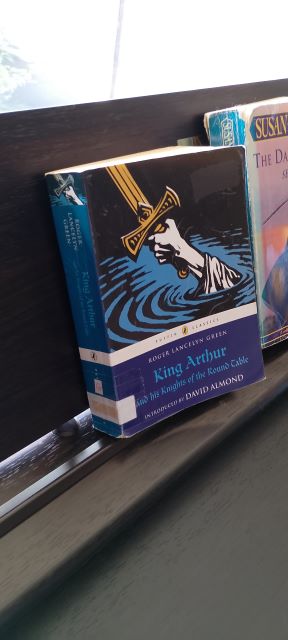
First published in 1953, King Arthur and his Knights of the Round Table was written by Roger Lancelyn Green and illustrated by Lotte Reiniger. This collection of stories mainly takes place in the peaceful land of Logres that Arthur established in Britain. Roger Green wrote this book with one purpose: putting the stand-alone legends of King Arthur and his knights together in a roughly chronological order.
To achieve his vision of a single narrative, Green separated this book into four collections of stories and an epilogue. The first book, ‘The Coming of Arthur’, follows the King as he forms a kingdom of peace, Logres, and protects it from early challenges along with his knights. Following the construction of the round table in the first book, the second, ‘The Knights of the Round Table’, features the origins of many of Arthur’s knights from Gareth to Tristram. The third book, ‘The Quest of the Holy Grail’, follows Sir Galahad and company as they search for the Holy Grail. Following many deaths from the search for the Holy Grail, the fourth book is called ‘The Departing of Arthur’ and follows the fall of Logres and the end of Arthur’s reign.
Reading this book has allowed me to gain a good understanding of the legends of King Arthur and his knights. The key reason for this is how the book has been ordered. Due to the chronological order, I knew why a hand reached out to grab Arthur’s sword as his last knight, Sir Bedivere, tossed it into a lake: this is the same hand that held out Arthur’s sword, Excalibur, when he first sailed out to claim his destined weapon. Green truly achieved his goal.
However, learning about King Arthur and his knights is only one of the reasons I found the book so interesting. The other is how different King Arthur and his Knights of the Round Table is to anything I’ve ever read. The main reason for this is it being a medieval legend without any monsters. The only other legends I’ve ever read are The Dragon’s Hoard and Beowulf. However, both of these heavily focus on fights against monsters, and lack the epic jousts and exciting duels of King Arthur and his Knights of the Round Table.
In Green’s book, he added in an epilogue, ‘Avalon’, set after the last story, ‘The Last Battle’. This epilogue completes the book as Green talks about what he thinks happened to King Arthur and Queen Guinevere, Sir Launcelot and Sir Bedivere. Without this, I would have been left wondering if King Arthur came back and what happened when Sir Launcelot returned to find Arthur gone.
While the book is recommended for those 9 and older, I would say the book is better for those who are 11 or older. This is because it can be difficult to remember who’s who, the plot can be hard to follow and there are complex names like Queen Morgana le Fay. If you want to learn about King Arthur and his knights in an action-packed book, this is for you.